
Hancock Projected Versus Actual Release
IDOC uses two estimates with different meanings. Projected Parole Date generally anticipates the end of the prison portion and movement to community supervision. Projected Discharge Date anticipates the later end of the sentence or supervision. Neither field alone proves that an event occurred. The strongest public sign of institutional release is a current PAROLE status paired with an actual Parole Date and a parole-district location.
A current IN CUSTODY label controls even when an older Last Paroled Date appears. That older field can document a prior release followed by return to custody. A count marked SENTENCE DISCHARGED?: YES must also be read beside every other count. One completed sentence does not end another active sentence.
| Record example | Correct reading |
|---|---|
| IN CUSTODY + future Projected Parole Date | The person remains in state custody; the date is prospective. |
| PAROLE + past Parole Date + PAROLE DISTRICT | The person left the institution for state supervision. |
| Future Projected Discharge Date | Final sentence discharge is expected later. |
| Old Last Paroled Date + current IN CUSTODY | A past release occurred, but current status is custody. |
Choose Hancock Release Date Records
Start with the custody system. A Hancock-only jail episode is not calculated by IDOC. A court commitment called a mittimus can send the person from the Hancock County Jail to IDOC; that jail departure is a transfer into state custody, not community release. A federal or immigration handoff also requires a separate locator and agency record.
- Pretrial detainee
- A person held while the case is pending. No sentence-based release date exists.
- County sentence
- A jail term governed by the judgment, credited custody time, and Hancock jail computation.
- IDOC sentence
- A state-prison term whose public record may show projected parole and discharge dates.
- Detainer
- A request or legal basis for another authority to take custody, which can prevent community release.
For a pretrial case, obtain the release or detention order from the Hancock Circuit Clerk, then call the jail about processing and other holds. A judge’s order supplies legal authority. The Sheriff’s log supplies the physical release date and time. For a county sentence, request the judgment, custody-credit finding, and jail computation rather than trying to apply a state-prison formula.
The Hancock County released inmate lookup explains how to request the complete county release record. Its destination field can distinguish release to the community from transfer to IDOC, another jail, BOP, ICE, or another authority.
Find Hancock Projected Release Dates
For an IDOC commitment, use the IDOC Individual in Custody Search. Search by IDOC number when possible because it is less ambiguous than a name. The public form also offers last-name and birthdate searches. Open the match and compare sentencing county and identifying information before relying on dates.
- Confirm whether the person is in Hancock jail custody, IDOC custody, or another system.
- For IDOC, search by IDOC number, birthdate, or last name and open the matching profile.
- Read current Offender Status before any date. Record the exact projected field label.
- Check all active counts, the actual Parole Date, location, and Projected Discharge Date.
- For a county sentence, request the court judgment and custody-credit finding, then ask the jail for its computation.
- For a pretrial case, check the current court order and ask the jail about processing and holds.
- Confirm the actual event later with an agency record or status update.
The official IDOC search page provides the state-prison route.
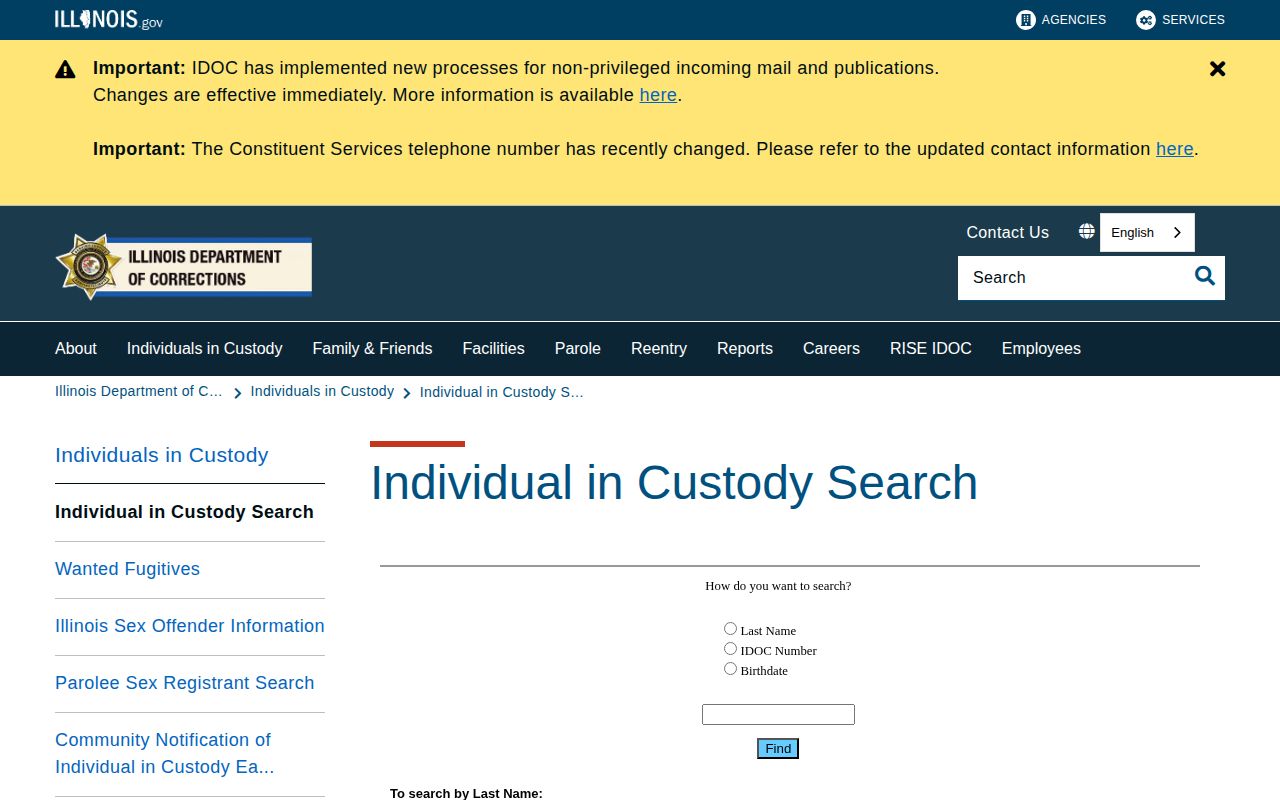
The image shows the correct agency entry point, not a Hancock county-jail calculator. Someone whose custody never reached IDOC may have no record there.
Fully discharged people can disappear from current web coverage. IDOC’s FAQ says the online search currently covers incarcerated or paroled people. If a former state prisoner is absent, call the public information line at 217-558-2200 and ask for existing admission, actual release, status, and final-discharge information. A no-result is inconclusive.
Illinois Sentence Credit Floors
Illinois sentence credit is governed principally by 730 ILCS 5/3-6-3. Many non-enumerated sentences receive one day of sentence credit for each day imprisoned, often called day-for-day credit. The statute has extensive offense and date exceptions. It is unsafe to assume that every Illinois sentence is cut in half.
Enumerated truth-in-sentencing offenses can have service floors commonly described as 85, 75, or 100 percent. Many listed violent or sexual offenses allow no more than 4.5 days of credit per month, which produces the familiar 85-percent floor. Other categories differ, while first-degree murder, terrorism, and natural-life terms have stricter rules. The current consolidated statute and actual judgment must be checked for the offense and sentencing date.
The Illinois sentence-credit statute illustrates those distinct floors.
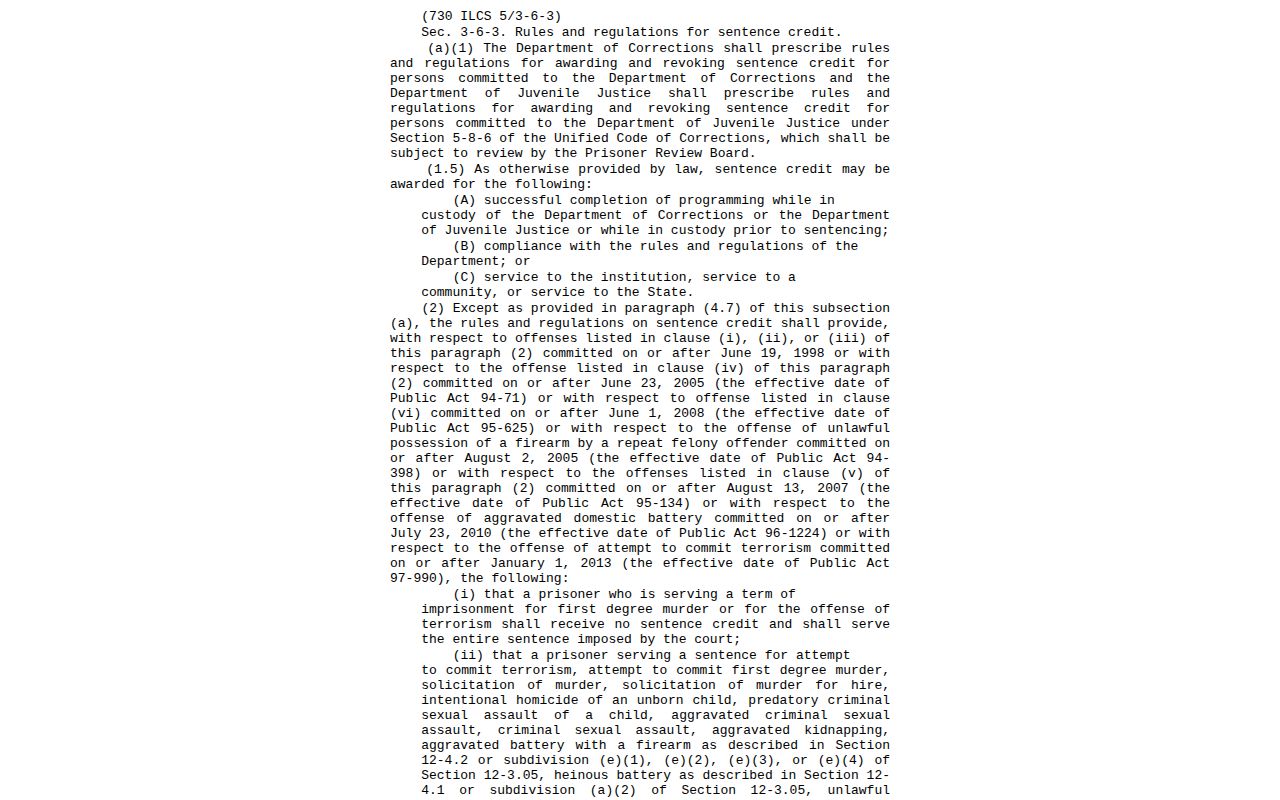
The statute’s categories show why a simple offense-class estimate is not reliable. Eligibility, offense date, sentence, and credit history all affect the calculation.
IDOC’s Director may award discretionary earned sentence credit, subject to eligibility. The cited framework allows up to 180 days for sentences under five years and up to 365 days for longer sentences, ordinarily after at least 60 days served including county time. Programs and specified achievements can create other credits. Covered truth-in-sentencing floors still apply, and credit may be revoked or restored.
Hancock Earned Credit Limits
Discretionary earned credit cannot be predicted from the public profile. IDOC states that eligibility does not guarantee an award and that the agency cannot say whether or when a person will receive it. Once a revision is made, the projected date may change on the profile. Until then, subtracting the maximum possible award creates a speculative date.
The IDOC earned-credit explanation supplies that warning.
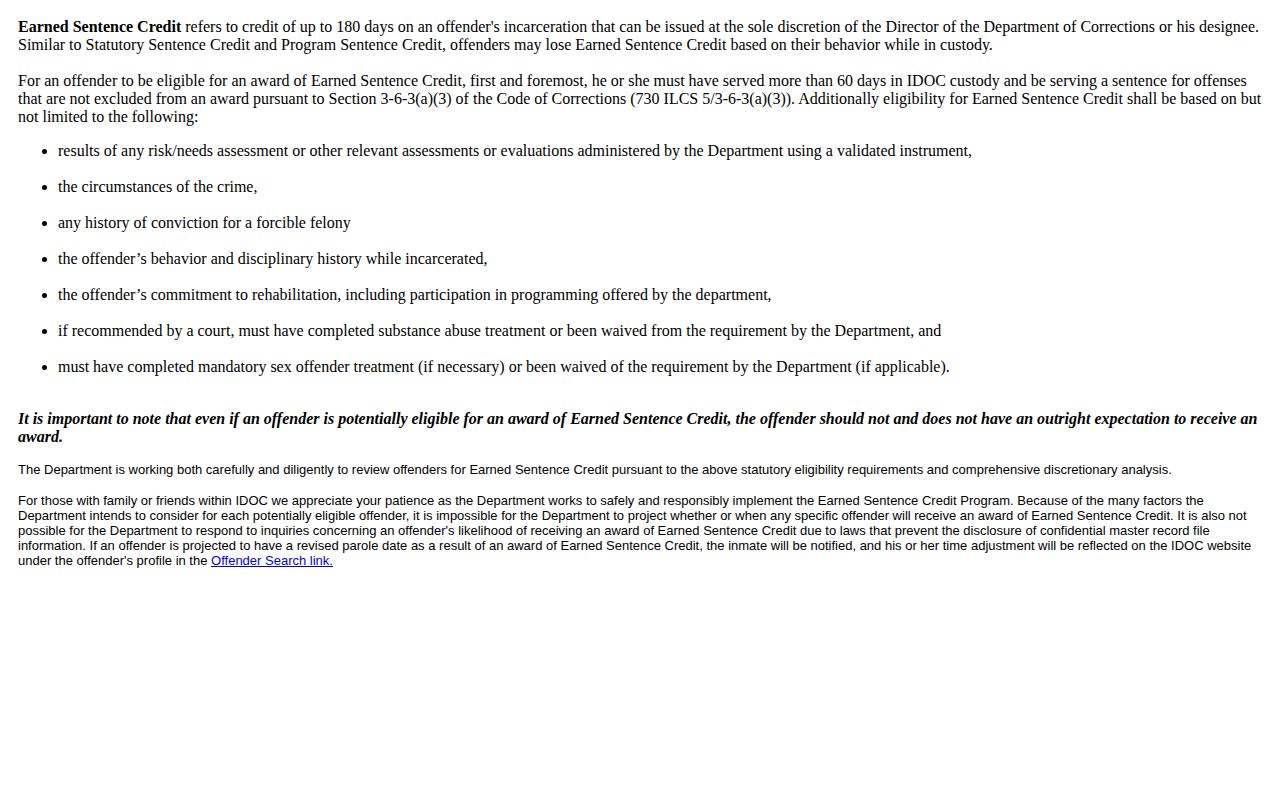
The official caveat links the estimate to credits actually reflected in IDOC’s calculation. It does not promise the largest award allowed by law.
Presentence custody credit can also matter. That is time credited for qualifying detention before the prison term. The court judgment and custody-credit finding are core source records. If those records are amended or corrected, IDOC’s date may change. Questions about the court’s award may require the Circuit Clerk, counsel, or court process, while questions about IDOC’s application belong with IDOC.
Why Hancock Release Dates Change
A projected date is recalculated as the controlling inputs change. Some inputs benefit the person, while others delay release or redirect the person to another custodian. The public profile may not explain every calculation step, so documentary questions should identify the exact date field and ask for the underlying existing record.
| Factor | Possible effect |
|---|---|
| Presentence custody credit | Qualifying prior custody can move the estimate earlier. |
| Earned or program credit | An awarded credit can reduce time within statutory limits. |
| Disciplinary loss or restoration | Credit changes can move the projected date later or earlier. |
| Amended court order | A corrected sentence or custody-credit finding can alter the computation. |
| Concurrent or consecutive terms | How counts run together affects the overall sentence end. |
| Detainer or receiving authority | The person may leave IDOC or Hancock custody but transfer elsewhere. |
| Parole violation recalculation | Return to custody can create a new current status and estimate. |
| Data correction | A corrected identifier or sentence field can change the display. |
A PRB decision can also be relevant in old-law, youthful-review, or revocation matters. Yet a grant is not the physical release date. Check current IDOC status after the decision. The Hancock County probation and parole page separates those Board functions from routine MSR and local probation.
Note: A release to another agency ends one custody episode but does not establish freedom in the community.
Hancock County Sentence Calculations
County-jail calculations are distinct from IDOC projections. The Hancock court judgment, the custody-credit finding, and the jail’s own computation control a county sentence. No Hancock-specific online good-time calculator, weekend-release rule, or public release schedule was identified. Applying IDOC’s Projected Parole Date formula to a county detainee would produce an unsupported answer.
Request the docket, judgment, sentencing order, and any amended order from the Hancock Circuit Clerk at 217-357-2616 or kweber@9thjudicial.org. Then ask the Hancock County Jail at 217-357-2115 for the recorded computation or release authority. If documents are needed, send a narrow written request to Sheriff FOIA Officer Maria Hopp, 98 Buchanan Street, Carthage, IL 62321.
Ask whether another hold or receiving agency applies. A state mittimus means transport to IDOC. Federal, immigration, or another county authority can also assume custody. The destination field prevents a projected county-jail exit from being mislabeled as community release.
Confirm Hancock Actual Release Dates
Return to the source system on or after the projected date. For IDOC, look for the actual Parole Date and current PAROLE status rather than the old estimate. For Hancock jail custody, obtain the Sheriff’s date, time, authority, and destination. For a court order, remember that authorization can precede physical processing while staff verify identity, paperwork, and other holds.
A Hancock County VINELink inmate search can register a custody-change alert for a matching covered record. Treat its timestamp as notification time, which may differ from the exact exit time. If it reports out of custody, call the reporting agency and ask whether the event was release to the community or transfer.
Keep the projected profile, later actual-status record, applicable court order, and agency release record separate. Together they show the calculation, legal authority, and completed custody event without forcing one source to answer all three questions.