
Hancock Three-Day Release Window
The official Sheriff navigation reviewed through July 16, 2026 did not provide a live roster, 72-hour release view, 24-hour release view, photo feed, or jail app. The county jail page and FOIA page likewise supplied no rolling recent-release tool. Other states have counties with the same name, so a search result headed “Hancock County releases” is not local evidence unless it belongs to Hancock County, Illinois.
A three-day window remains useful as a request boundary. It can capture a Friday-to-Monday period or a multi-day gap between a court event and a records check. Yet there is no supported Hancock feed cadence, retention period, refresh schedule, or list-field set. Do not describe the window as rolling by the hour or resetting at midnight. Those features were not found.
Check Hancock Releases Over 72 Hours
Start with the jail record, then use durable court documents. This order helps resolve delayed reporting and transfers without treating an online absence as proof.
- Call the Hancock County Jail at 217-357-2115 with the name, birth date if known, and approximate booking date.
- Ask whether the person is now in Hancock custody and whether a departure occurred within the defined three-day range.
- Request the date, time, authority, release type if recorded, destination, receiving agency, and booking number.
- Send a narrow written request to the Sheriff FOIA officer when documentary proof is needed.
- Ask the Circuit Clerk for the docket and operative order. Follow an IDOC, federal, or other-agency transfer in that system.
For the latest same-day event, use Jail Releases: 24 Hours. For a broader named-person search, including IDOC, VINE, and federal paths, use the Hancock released-inmate search.
Hancock 72-Hour Record Fields
Because no online three-day feed exists, these are the release-log fields to request. The 2024 IDOC jail inspection supports the jail’s use of positive identification and recorded date, time, and authority for discharge, transfer, or release. Public access to each field still depends on the record and applicable law.
| Field | What it resolves |
|---|---|
| Full name and booking number | Matches the correct custody episode. |
| Booking date and time | Tests whether the event falls in the chosen range. |
| Release date and time | Shows when county custody actually ended. |
| Release authority | Points to the judge’s order, sentence event, dismissal, or other basis. |
| Destination or receiving authority | Separates community release from transfer. |
| Court or case number | Provides a route to durable court documents. |
Ask for the recorded wording. Do not force staff to label an event “freed” when the source says transfer or pickup. A person may leave Hancock custody and remain confined elsewhere.
Weekend Hancock Release Checks
No county source publishes a special weekend or holiday release rule. The safest questions concern the exact event: Did a judge authorize release? Has the jail verified other holds? Was the person positively identified and processed? Did another agency take custody? What date and time does the log show? A court ruling and physical exit can occur at different times.
VINE may help with an alert, but it can update after the actual event and can describe the end of one agency’s custody during a transfer. Search the matching person, compare identifying details and reporting agency, and save the alert’s time and exact text. Then call the reporting agency. The Illinois VINE portal is an alert and lookup layer, not a certified three-day release list.
Weekend timing also makes the court record useful. A pretrial release order, dismissal, sentence, or mittimus can persist after the jail event becomes hard to trace. A mittimus is the court document committing a person to custody, often IDOC. It signals transfer rather than release home.
FOIA Is Not a Release List
Illinois FOIA has a 72-hour rule for specified arrest-report information under 5 ILCS 140/2.15. That provision is not a rolling 72-hour jail release feed. Arrest information concerns the arrest event. A release record concerns when and why county custody ended and where the person went. Conflating the two can turn an old booking entry into a false statement about current status.
The distinction matters in Hancock because local news archives may preserve Sheriff arrest logs. A WCAZ item can help identify a booking date, charge, or spelling. It commonly lacks the final release timestamp and destination. Use it only to narrow a jail or court request.
The successful manifest image below shows the Illinois arrest-report source associated with this distinction. Read the official statute before treating its 72-hour language as a release rule.
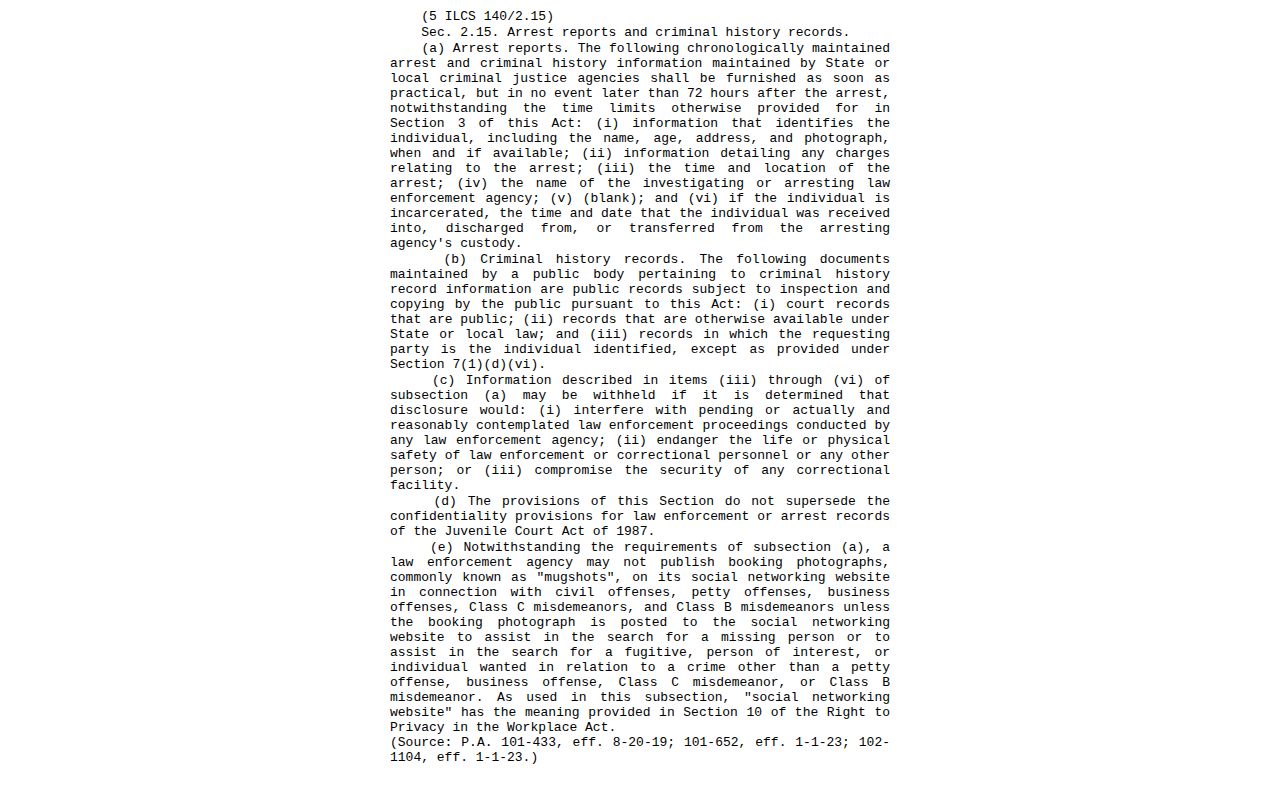
The statute screenshot explains the arrest-information rule; it does not supply names of people released from Hancock County Jail.
Request Hancock Three-Day Records
The Hancock County FOIA page names Sheriff FOIA Officer Maria Hopp and gives 98 Buchanan Street, Carthage, IL 62321 for written requests. No dedicated form or email was published for the Sheriff request. Define the three-day range and the person or narrow group of bookings. Ask for electronic copies of existing records.
A precise request seeks the booking and release record, departure date and time, authority, destination or receiving agency, and court or case number. Request the booking photograph separately if needed. If the agency withholds or redacts a portion, ask for the statute used and the reasonably separable nonexempt material. The county refers to section 6 of FOIA for fees and does not publish a custom Sheriff fee chart. Response timing can depend on classification and an authorized extension, so avoid a blanket deadline promise.
Hancock County Sheriff FOIA OfficerMaria Hopp
98 Buchanan Street
Carthage, IL 62321
Jail line: 217-357-2115
Cross-Check Hancock Court Records
The Hancock Circuit Clerk provides scheduling and copy-request information but does not clearly advertise a public criminal-case locator. Begin with party name, approximate case year, and a case number if known. Ask for the docket or register of actions. It identifies the document that best explains the departure.
| Case event | Document to request |
|---|---|
| Pretrial release | Release or detention order and later changes |
| Sentence | Judgment, custody-credit finding, and mittimus |
| Dismissal or acquittal | Disposition order |
| Probation completion | Termination or discharge order |
| Changed sentence | Amended order and relevant appeal record |
The court proves judicial action in the case. The Sheriff log proves physical processing. Another hold may remain after dismissal or release in one case. Sealing, expungement, juvenile confidentiality, or impoundment can also limit public access.
Interpret Hancock Custody Outcomes
If IDOC receives the person, check Illinois Department of Corrections records. A current PAROLE status and actual Parole Date support departure from the state institution to supervision. A future projected date is only an estimate. An IN CUSTODY status controls over an earlier parole date. Fully discharged people may fall outside the public web search, so the IDOC public line or record request may be needed.
- Community release
- County custody ends and no receiving custodian is identified.
- Transfer
- Hancock’s episode ends while another agency immediately takes custody.
- Discharge
- A sentence or supervision obligation ends; it is not always the same date as jail release.
- Out of custody alert
- A reporting agency stopped reporting custody, subject to confirmation of destination.
No result in a roster, VINE, IDOC, or court source should be read alone. Spellings, coverage, feed delays, full discharge, sealing, and transfer can each explain absence.