
Where an IDOC Release Leads
Illinois Department of Corrections institutions hold people committed under state sentences. They are not Hancock County jail facilities, and the statewide system does not cover a person whose custody ended after only a county-jail stay. When a Hancock County court commits a person to IDOC, the departure from the Hancock County Jail is a transfer into state custody. The sentencing judgment and mittimus support that transition, while IDOC then becomes the source for later state status.
Most people leaving a modern determinate state sentence enter mandatory supervised release, commonly called MSR. The public database uses legacy labels such as PAROLE, Parole Date, and PAROLE DISTRICT for this community phase. That means the person has left the prison institution for supervision. It does not mean the whole sentence is discharged. A future Projected Discharge Date can show that state supervision or another sentence obligation remains.
A Hancock jail handoff to IDOC is a transfer, while an IDOC status of PAROLE with an actual Parole Date supports institutional release to supervision.
How to Confirm an IDOC Release
The official search offers three entry routes. IDOC number is usually the least ambiguous, but a name or birthdate may work when that number is unknown. Use the current status as the starting point, then interpret each date by its exact label.
- Open the official IDOC Individual in Custody Search and choose Last Name, IDOC Number, or Birthdate.
- Enter the available value, select Find, and open the matching result.
- Compare the identifying details and sentencing county carefully so a common name is not mistaken for the intended person.
- Read
Offender Statusbefore relying on any older or future date. - For institutional release, look for
PAROLEtogether with an actualParole Dateand a parole-district location. - Review every sentence count and any projected discharge field before describing final discharge.
The official IDOC search landing page explains the state lookup and links to the search interface.
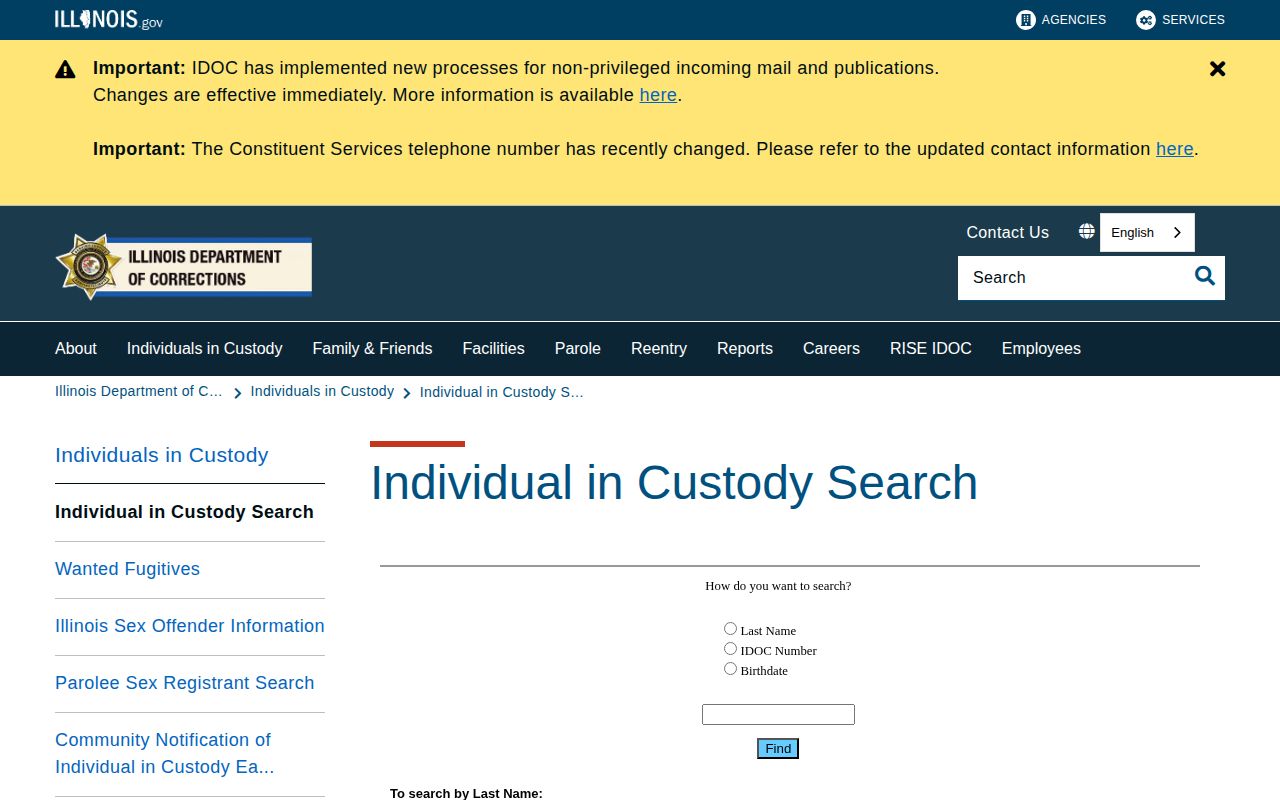
This state portal is appropriate only after an Illinois prison commitment or when checking IDOC supervision. A Hancock-only release still belongs with the Sheriff and court record paths described in the Hancock County release guide.
IDOC Status and Date Fields
A single profile may contain dates from different stages of the sentence. The wording is not interchangeable, and the newest controlling status should be read before older history.
| Field | What it establishes |
|---|---|
| Offender Status: IN CUSTODY | IDOC currently reports imprisonment, even if an earlier Last Paroled Date appears. |
| Offender Status: PAROLE | IDOC reports release from the institution to community supervision, not final discharge. |
| Parole Date | An actual institutional release date when paired with the current PAROLE status. |
| Projected Parole Date | A prospective calculation that can change; it is not proof of release. |
| Last Paroled Date | A prior release event that does not override a current IN CUSTODY status. |
| Projected Discharge Date | The anticipated end of the remaining sentence or supervision, not an event already completed. |
| SENTENCE DISCHARGED?: YES | That specific count is discharged; every other count must also be checked. |
| Parent Institution or Location | The assigned institution or parole district, which helps explain the present status. |
A Prisoner Review Board grant can be relevant in an eligible case, but a Board decision may precede the physical release. Return to the IDOC record for the actual status and date. Old-law discretionary parole mainly concerns pre-1978 sentences, while youthful parole review is a separate process and does not make release automatic.
When the IDOC Search Finds Nothing
IDOC states that its current web results cover people who are incarcerated or on parole. A fully discharged former prisoner may therefore be absent. No result does not prove that the person never entered state custody, and it does not confirm a county release. A spelling mismatch, incomplete identifier, data issue, or custody in a different system can also explain the result.
Try name variants, birthdate, and IDOC number if available. If the profile remains missing or unclear, call IDOC public information at 217-558-2200. Provide the full name, birthdate, approximate admission year, and sentencing county. Ask for the admission date, actual release or parole date, present or final status, and final discharge date. The separate 1-888-446-9103 line is restricted to government and law-enforcement users and is not the general public route.
IDOC Records and Public Contact
IDOC is a statewide correctional system composed of institutions and community supervision operations. The statewide system does not have one prison address or visiting desk. The public information number is the supported statewide contact when the online profile does not answer a former prisoner's status.
Illinois Department of Corrections
Individual in Custody Search: idoc.illinois.gov/offender/inmatesearch.html
Public information: 217-558-2200
Coverage: People currently incarcerated or on parole in the IDOC web search
Records fallback: Request the existing admission, release, status, or discharge record from IDOC
Be precise about the document requested. A useful request identifies the person and seeks the maintained admission date, actual parole or release date, current status, projected or final discharge information, and relevant sentence counts. If a field appears wrong, identify that field and supply the authoritative court document. A sentencing-order issue normally belongs with the court, while an IDOC calculation question belongs first with IDOC and may also require counsel or court review.
Why an IDOC Projected Date Changes
Projected Parole Date estimates departure from the prison portion of a sentence. Projected Discharge Date estimates completion of the remaining sentence and supervision. Neither is an actual release field. IDOC may revise a projection when the underlying legal or administrative calculation changes.
- Presentence custody credit is added or corrected.
- Program or earned sentence credit is awarded.
- Credit is lost through discipline or later restored.
- A court amends an order or corrects sentencing data.
- Concurrent or consecutive sentence relationships change the computation.
- A parole violation causes recalculation or return to custody.
Illinois sentence credit is governed principally by 730 ILCS 5/3-6-3. Many non-enumerated sentences use one day of credit for each day imprisoned, but the statute contains major offense and date exceptions. Certain truth-in-sentencing categories have service floors commonly described as 85, 75, or 100 percent. It is inaccurate to assume that every Illinois prisoner serves half a sentence or that every violent offense follows one percentage.
The Director may award discretionary earned sentence credit within statutory limits, and some programs or achievements can generate other credit. Eligibility does not guarantee an award. Credits also cannot reduce a covered truth-in-sentencing sentence below its statutory floor.
The IDOC earned-credit explanation warns that discretionary credit cannot be predicted for an individual.
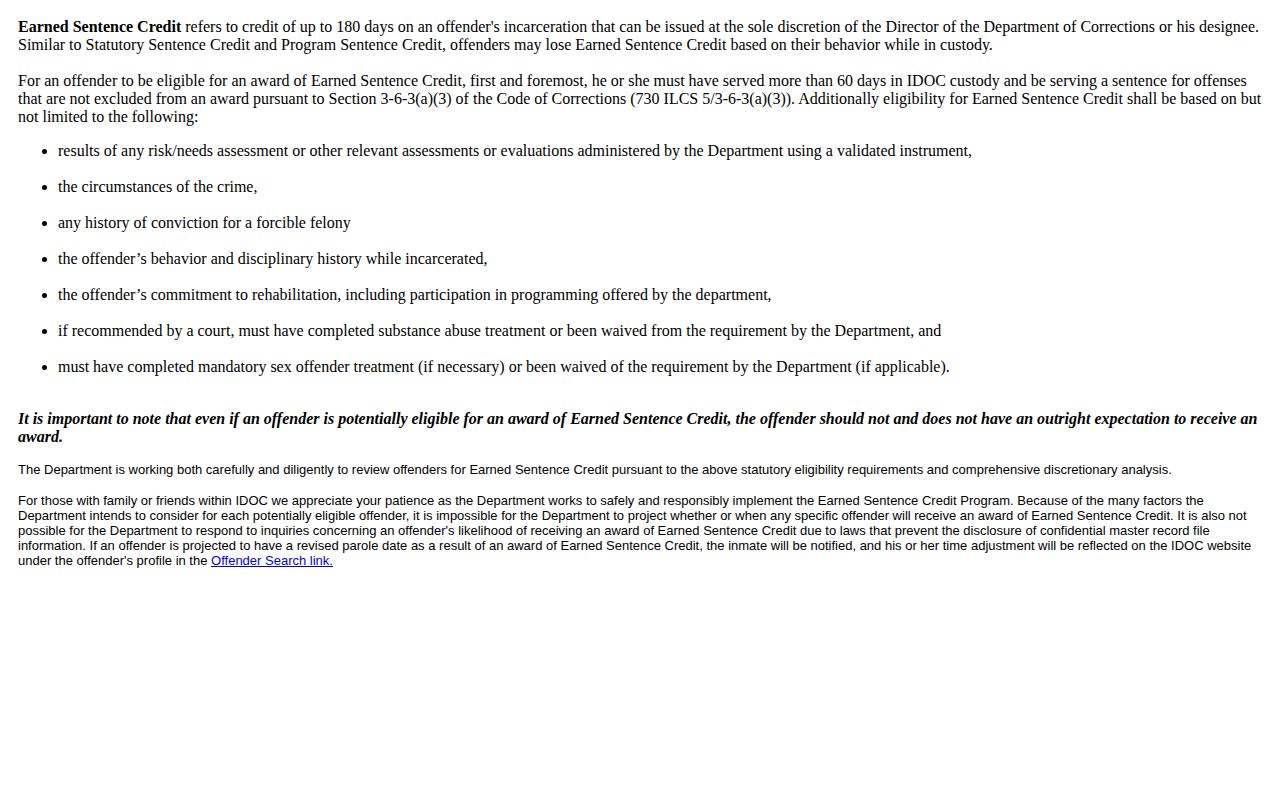
The public profile can reflect a later award, but the reliable confirmation of release remains the updated status plus an actual Parole Date.
Hancock County Jail Versus IDOC Custody
County and state records answer different questions. The Hancock County Sheriff documents when a person leaves the county jail, the authority for that departure, and whether another agency received the person. A Hancock Circuit Court judgment and mittimus can show commitment to state prison. IDOC then reports the person's status during state custody and, while web-covered, community supervision.
Someone can therefore be recorded as leaving Hancock County Jail without being free in the community. If the receiving authority is IDOC, the county episode ended through transfer. Conversely, a person who completes a county-jail sentence without entering state prison may never appear in IDOC. The Hancock County Jail page covers that local release and records route.
| Question | Best source |
|---|---|
| When did the person physically leave Hancock County Jail? | Sheriff release record with date, time, and authority |
| Was the county departure a transfer to state prison? | Sheriff destination record plus court mittimus |
| Is the person now imprisoned by IDOC? | IDOC current Offender Status and institution |
| Did the person leave an IDOC institution for supervision? | PAROLE status plus actual Parole Date and parole district |
| Has the entire state sentence ended? | All count-level discharge information and an IDOC final-status record |
Transfers Beyond the Illinois State System
IDOC data should not be extended to federal or immigration custody. The Bureau of Prisons locator covers sentenced federal custody from 1982 forward. A BOP result marked Released or Not in BOP Custody ends BOP's reported custody but can coexist with federal supervised release or another custodian. Federal pretrial and Marshals custody may require the federal court docket because there is no equivalent public historical Marshals locator.
ICE uses its own detainee locator and reports a limited 60-day window for people released from ICE custody. An agency handoff is not automatically community release. Illinois VINE may provide event alerts for participating state feeds, but an out-of-custody message still needs confirmation from the reporting agency when transfer versus community release matters.
About IDOC Statewide Institutions
The Facility Map includes Illinois Department of Corrections statewide institutions because a Hancock County criminal case can result in state commitment even though no state prison was identified within Hancock County itself. The relevant facility can change as IDOC assigns or transfers a sentenced person. For release research, the statewide offender record is therefore more durable than assuming the person remained at the first institution.
IDOC institutional release often begins a separate supervision phase administered through IDOC Parole Services. The Illinois Prisoner Review Board handles defined hearing, condition, and revocation functions, but it is not a universal release gate for every modern sentence. Local Hancock County probation is also separate. It results from a court sentence and is managed through Hancock County Court Services, not through an IDOC prison profile.
Keep the evidence in order: current IDOC status and actual date, an existing IDOC release or status record, a PRB decision when legally relevant, and the sentencing judgment or mittimus. A projected date or a Board decision alone comes before the actual event. That sequence avoids calling a future estimate, an institutional transfer, or release to supervision a final discharge.