
Hancock County Supervision Types
Four systems can appear around a Hancock County release. The Hancock County Court Services office handles local probation and names a local pretrial officer. IDOC Parole Services supervises people who leave an Illinois prison for mandatory supervised release, commonly shortened to MSR. The Illinois Prisoner Review Board, or PRB, conducts certain parole and revocation proceedings. A court order remains the best source for the basis and term of local supervision.
These labels should not be blended. Probation is a sentence served in the community under the circuit court. Pretrial services monitor some people before the criminal case reaches final disposition. MSR is the supervised portion that follows a determinate state-prison sentence. Traditional discretionary parole mainly concerns older indeterminate cases and certain special review paths.
| Status | Who controls it | Best verification |
|---|---|---|
| Probation | Hancock Circuit Court and Court Services | Docket, sentencing order, and local office |
| Pretrial supervision | Hancock Court Services | Pretrial order and local officer |
| MSR / database “PAROLE” | IDOC Parole Services | IDOC status, Parole Date, and parole district |
| Old-law or youthful review | Illinois PRB | Applicable docket, result, and later IDOC status |
- Probation
- A court sentence served under community rules instead of, or after, confinement.
- Mandatory supervised release
- A supervised term that follows many determinate IDOC prison sentences.
- Parole
- Conditional release from prison; IDOC also uses this legacy label for many people on MSR.
- Discharge
- The end of the sentence or supervision term, not merely release from a building.
Verify Hancock County Parole Status
Start with custody type. A person whose case never resulted in an IDOC commitment will not gain a state parole record from that Hancock jail stay. For a state-prison case, the IDOC Individual in Custody Search is the first public check. Read the complete result. A current status of PAROLE, an actual Parole Date, and a PAROLE DISTRICT location together support release from the prison institution to supervision. A future Projected Discharge Date means final discharge has not yet occurred.
An older Last Paroled Date does not override a current IN CUSTODY status. Likewise, one count marked SENTENCE DISCHARGED?: YES may coexist with another active count. Fully discharged people may be absent because IDOC says its current web coverage is limited to incarcerated or paroled people. In that case, call IDOC’s public line at 217-558-2200 or request the existing admission, release, status, and discharge record.
- Decide whether the person had a Hancock probation case or an IDOC prison sentence.
- For IDOC custody, search by IDOC number when available, then compare name, birthdate, sentencing county, and current status.
- Look for an actual Parole Date and parole-district location. Do not treat a projected date as an event.
- For local probation, obtain the Hancock docket and operative sentencing or termination order from the Circuit Clerk.
- Call the correct supervising office when the public record is missing or unclear.
Hancock County Probation Office
Hancock County maintains its own Court Services team. The Office of Statewide Pretrial Services county page expressly says Hancock is not served by that statewide office. Local Court Services is therefore the relevant route for Hancock probation and pretrial questions. A staff listing helps route a call, but the court order and docket establish the legal status.
500 Main Street, Suite 3A
Carthage, IL 62321
Phone: 217-357-2033
Fax: 217-357-2051
The official Hancock County probation page shows the local office and staff structure.
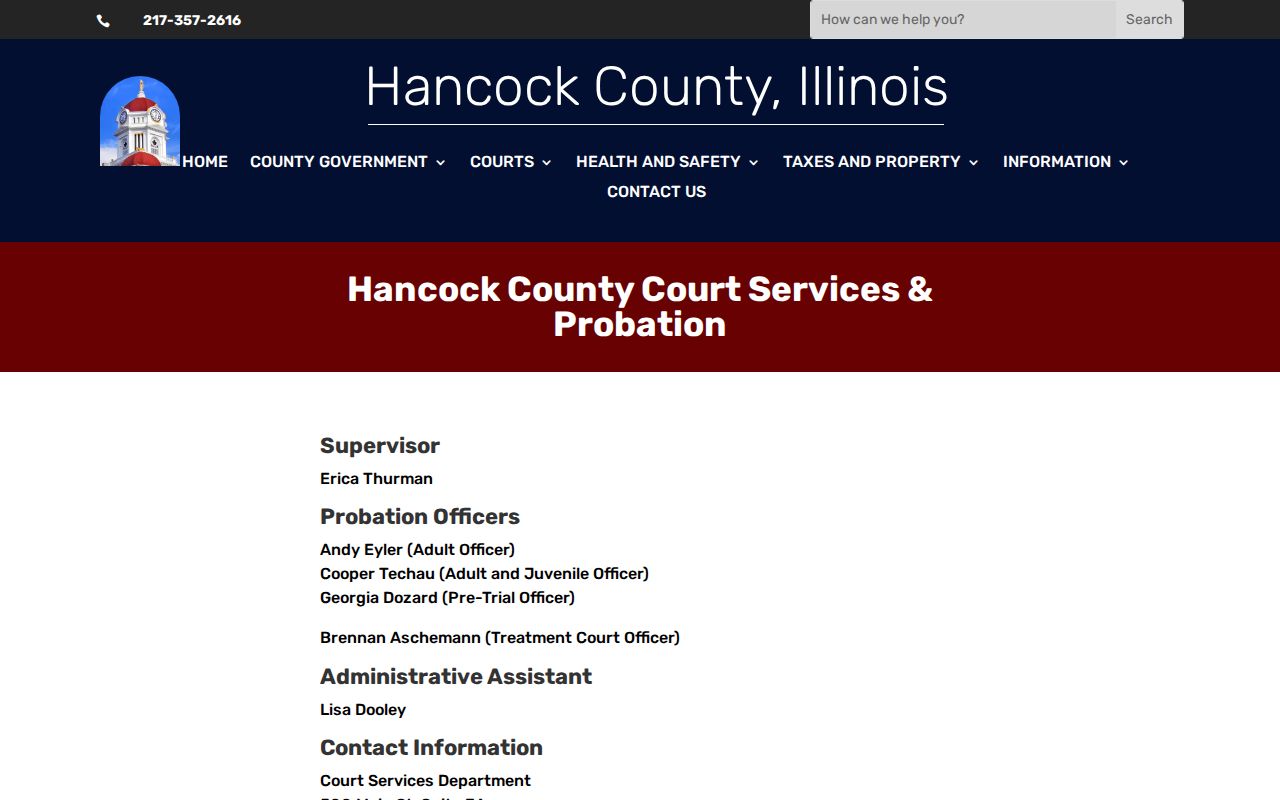
The county page confirms that local probation and pretrial contacts belong to Court Services, not IDOC Parole Services or the statewide pretrial office.
The official page lists Supervisor Erica Thurman, adult officer Andy Eyler, adult and juvenile officer Cooper Techau, Pre-Trial Officer Georgia Dozard, and Treatment Court Officer Brennan Aschemann. Ask which record or office can confirm the current term. Do not infer that a person is supervised merely because an officer handles the type of case.
For a durable copy, contact the Hancock Circuit Clerk at 500 Main Street in Carthage, 217-357-2616, or kweber@9thjudicial.org. Request the docket and the exact order needed, such as the sentence, modification, probation termination, or discharge order. A termination order is stronger evidence of completed probation than an old case entry viewed alone.
Hancock Parole Board Records
The Illinois Prisoner Review Board handles functions that differ from routine probation supervision. Its materials include calendars, en banc agendas and results, approved minutes, old-law parole matters, youthful review, and revocation proceedings. A calendar shows that a matter is set. It does not show that release occurred. A Board grant or favorable result must still be checked against the later IDOC status and actual date.
Modern determinate sentences generally lead to MSR under Illinois law, not a discretionary vote for every release. Old-law parole applies to narrow pre-1978 indeterminate cases. Youthful parole review under 730 ILCS 5/5-4.5-115 creates review eligibility for qualifying cases; it is not automatic release. PRB Operations accepts case and hearing questions at 217-782-7273 or prb.operations@illinois.gov and asks that the mailbox not be used for FOIA requests.
Current en banc results can document a decision before approved minutes appear. The Past Paroles registry is useful only for its narrow old-law population. Revocation results may return someone to release, add conditions, find no violation, or revoke release and return the person to custody. Each result needs a current IDOC cross-check.
Hancock Supervision Violation Records
A supervision violation allegation does not establish the final outcome. Preliminary and final revocation processes can lead to continued release, changed conditions, or return to IDOC. An absconder is a person alleged to have stopped reporting or left supervision without authorization. A warrant is a court or agency command for arrest. Neither label should be inferred from a stale article, an absent web result, or a hearing schedule.
No official live Hancock Sheriff warrant or absconder list was identified. Verify a claimed local warrant with the Sheriff and Circuit Clerk. For an IDOC supervision matter, compare the PRB revocation result with the current IDOC record. If public safety is at issue, contact the responsible agency and do not approach the person.
Illinois VINE may send custody-change alerts for covered records, but it is not a supervision warrant database. The Hancock County VINELink inmate search can help track a reported custody event. An alert still needs confirmation from the agency that supplied it.
Hancock Release Reentry Continuity
The 2024 IDOC jail inspection documents a local bridge toward reentry. Hancock added free telephone calls so detainees could begin rehabilitation and reentry work. The report identifies Mental Health Centers of Western Illinois as the jail’s mental-health provider. These details do not promise a service or outcome for every released person, but they identify questions that can be raised before departure.
For a detainee with mental-health needs, the inspection checklist asks whether staff provide a community resource list, an opportunity to obtain medical or medication records, and a referral, prescription, or two-week medication supply when appropriate. A family can ask the jail what was arranged in the individual case. After release, probation or parole conditions may require contact with treatment providers, so preserving the discharge paperwork and medication plan can reduce confusion.
Supervision conditions vary by order and case. The court, IDOC Parole Services, or assigned officer is the source for current terms. The broader Hancock County released inmate search explains how to pair those supervision records with the actual jail or prison release record.
Hancock Release Property Records
Release also creates a paper trail for ordinary property. Illinois’s county-jail checklist expects staff to inventory and return personal property and to retain the signed itemized receipt permanently. When clothing, funds, or another inventoried item is disputed, request that receipt with the booking and release record. The receipt can show what staff recorded as returned, but it does not decide ownership of evidence held for a case.
Evidentiary property follows a separate process. The Sheriff’s Evidence and Property page states that pickup may require an appointment, photo identification, proof of ownership, and authorization from an investigator or prosecutor. A probation discharge does not automatically release evidence. Ask which agency holds the item and which authorization remains necessary.
Keep copies of the signed receipt, release record, court order, and any written property response. Those records separate the physical exit from later supervision and property questions. Note: A property record can support a dispute, but it does not establish the end of parole or probation.